A Lesson in Parental Superpowers

“The only real mistake is the one from which we learn nothing” – John Powell

It’s my view that somewhere, way up there, is a higher power, whose job it is to keep us parents in check. To ensure we don’t become too smug, comfortable or complacent. It’s for this reason that once you stop for a second, congratulate yourself for a job well done or a parenting catastrophe avoided, an inevitable disaster will follow. Like the time, very recently, that I made it to the check-out at the supermarket with both of my children still in my sight (actually, they were both still in the trolley. Double win). I managed to employ Monkey as my trolley-unloader and a whole weeks’ shopping was subsequently packed into those ridiculous plastic bags (which are getting THINNER and THINNER on a weekly basis, are they not?! G-d forbid you should try to pack a cucumber in one of those suckers. Cucumbers are akin to hot knives through butter when it comes to slicing open Tesco carrier bags, leaving your perishable produce rolling down next door’s driveway and under their car wheels. I’ve lost entire melons this way. Cucumbers are NOT our friends). But I digress, where was I?

Oh yes, I was at the front of the check-out. Shopping packed. Children still behaving. Smug. Somewhat jubilant. Planning a celebratory Facebook status update.

“That’ll be one hundred and whatever pounds, please.” Said the cashier. “Do you have a Clubcard?”
“Yes, I do.” I said. Feeling a bit like one of those organised and together mothers that you see. You know, the ones who don’t forget their re-usable carrier bags and don’t let their children play with their iPhones to keep them quiet in shops.

“My Clubcard is right here, in my…….ohhhhhh”.

At this juncture I felt I deserved extra parenting points for not swearing.

My purse was not in my handbag. I was at home. In the kitchen. On the floor, where Madam had been playing with it.
So, back in the car we went. Of course a thunder-storm of biblical proportions had commenced during our time in the store. Of course we weren’t parked anywhere near the entrance to the store either, thanks to several builders taking up residence in the designated parent-and-child spaces. Of course we weren’t at the supermarket closest to home. Needless to say we hit the school-traffic. It goes without saying that screaming and crying ensued. From all three of us, in fact.

But I learned a lesson that day. Never get too smug. And always check that you have the means to pay for your groceries. My son will now always ask me if I’ve remembered my purse before we go anywhere. And I also now keep an emergency credit card hidden in my car, for emergencies (but don’t tell anyone).

Supermarkets are a parenting minefield. I often think that rather than loyalty cards there should be someone standing at the exit with a congratulatory glass of wine. Or at least a bar of chocolate. I mean, I find it completely impossible to even dress appropriately for a supermarket shop. No matter how cold it is in the freezer aisles, if I have children with me, I will always be sweating. There will always be a crucial item way back by the door that I have forgotten. If I have been organised enough to write a shopping list, it will inevitably still be at home. If I have remembered the list, I will forget to look at it. If I look at it, I won’t cross things off. So I’ll still require several more arduous trips to the supermarket in days to come. Even online shopping seems to result in several extra visits to the shops. I have a theory that supermarkets deliberately withhold items from your delivery to force you back in to their stores to top-up and spend more money.

I wonder if I’m the only person who occasionally forgets that sometimes there isn’t a child present when I shop. Who every-so-often rocks a childless trolley back-and-forth and asks it which yoghurt mummy should buy this week…? Probably just me, then.

br />

20130613-120145.jpg

I find looking on the bright side is a useful skill when it comes to dealing with small children; when they emptied an entire box of tampons in to the bath a few weeks ago, I was actually quite pleased. At least on this occasion it wasn’t an entire loo roll. The strings made them quite easy to remove from the bath and, unlike toilet paper, they didn’t dissolve and block the drains. Every cloud, see? Lesson learned: Place tampons on higher shelf.

Speaking of bright sides, sometimes my domestic slovenliness has advantages.

For example, I was grateful for the fact that there was a pile of clean laundry which required my attention, when Madam emptied an entire pint of water in to my underwear drawer. (Well actually, she didn’t empty all of it in my drawer. Some of it she tipped on my head in order to wake me up. I’ve filed that strategy away for when she’s a teenager). So luckily, in this instance, my somewhat disorganised laundry system prevented me from going bra-less and commando on the school run. Winner.

20130612-161635.jpg

Sometimes it feels like we need superpowers to get through everything required of us in the average day.

Parents are a bit like superheroes, really. Sadly, though, I haven’t worked out how to use my powers for good. For example, I only need a fleeting thought to enter my head for it to come true. Only yesterday I registered that it had been weeks since I’d been up in the night with one of my children. Of course, lo’ and behold I heard the 3am call of “Mummmmmyyyy, I want to get in your bed.” Superpowers, see? I made that happen. Similarly, I only need to observe that I haven’t wiped a snotty nose for a while for one of my children to instantly come down with a cold. It’s a similar logic that ensures that it will ALWAYS rain the day I paint my toe-nails. How does this work?! And why can I not use this power for lottery wins or solving the middle eastern peace crisis once and for all?

Often I think that resolving the conflict in the Middle East would be far simpler than refereeing a room full of three year olds having a playdate. I wish I knew the reason why one lone, broken and forgotten little car will suddenly become the most sought-after toy since the Cabbage Patch Doll phenomenon in the ’80’s. Everyone wants it. Superhero powers would come in handy here, but I find diversionary tactics work better.

Did you know that children have Super-powers too? Take afternoon sleep, for example. Children have a unique power to turn a five minute nap in the car at 5pm in to the equivalent of a three hour sleep. It’s worth more than the sum of its parts. One of the only things I remember from science lessons at school is the equation for speed. Speed = Distance divided by time. I wonder if a similar sum applies to car sleep. Rest earned = miles per hour multiplied by proximity to bed-time, or something. I only wish I could recharge my batteries as quickly as my two year old can in a car-seat with a five minute power nap. It’s a super-power, I tell you. And you can kiss that nice quiet evening on the sofa goodbye as a result.

These kids can turn things invisible, too. Either that, or somewhere in my house there’s a secret room to which only they have a key. It currently holds one very small red slipper, one half of a pair of cordless telephones (which I keep thinking I’ve finally found, only to have my hopes crushed when I realise it’s the same one, again.), a remote control, a favourite bowl, a very first shoe and several cosmetic items.

It’s interesting how for much of the day I’d like nothing more than a few minutes’ peace. But any parent of littles will tell you that there is absolutely nothing as suspicious as the sound of silence in a household containing awake children. My wooden floor will never be the same after my two emptied an entire, large tub of sudocrem everywhere in the time it took me to go upstairs, have a wee an put on my shoes. Of course they were dressed in their nicest clothes. Of course we were running late for a lunch date. Have you ever tried to remove sudocrem from skin? That stuff is designed to stick. I practically needed a sandblaster to remove it from them. I was just about to remark that they haven’t tried doing that again. I won’t though. For reasons stated above.

It’s my experience in my four years’ of parenting that whilst mistakes are plentiful, learning is continuous. Most days I learn something new. It’s not always something that I need to know, though. Like the fact that the simultaneous wearing of three contact lenses induces headaches, for example.

Often your children even enlighten those around you with knowledge. Such as, when I was using the loo next to the doctor’s waiting room. My son announced loudly that I was having a poo. I wasn’t, as it happens, but I thought there may have possibly been one person in the waiting room that hadn’t heard him, so I decided against clarifying the situation to my fellow patients.

I have learned to never, ever put your own coat on before those of your children. I think it’s a similar logic to fastening your own oxygen mask before anyone else’s on an aeroplane. Putting your own coat on and subsequently trying to fasten zips on two moving targets in a recipe for disaster, bad-temper and possible collapse.

I have learned that spontaneous mooing can, on occasion, divert the mother-of-all meltdowns. That you should never, EVER, remark that your child has never poo’d in the bath. (See reverse super-power point, above.) In related news I learned that those little stacking cups with holes in the bottom are useful for sieving said-poo from the bath.

I have learned to always ask exactly where on a plate a child would like their ketchup. This is one mistake I have not made twice, I’m pleased to say.

I have learned that when your child wishes you good luck rather than goodnight, you’d better brace yourself.


20130612-162013.jpg

But more than anything I’ve learned that every shocking day, is usually and conversely followed by a good one.

Keep smiling, mummies! Bye for now.

Guest Post: When I Grow Up, I Want to be Like My Children.

I’m lucky enough to be on holiday at the moment. I’m hoping to write a post during my break, but so far, on day three we’ve managed to lose Monkey once, Madam has escaped from her cot (head-first) and we’ve had several smashed glasses in restaurants! Luckily we’re in a family friendly resort and there’s usually several children misbehaving at any one time, so we feel right at home!

I’m sharing a post that my dear friend Lizi posted last night. It’s from her blog Through Accepting Limits which you can find here. Lizi has four year old twins, J&L. They’ve been in our lives for only a year but it feels like we’ve known them forever. I strongly suggest you read and devour every word on her site. You’ll be glad you did.

20130510-113938.jpg

When I Grow Up, I Want to be Like My Children

About six months ago, L started to notice that J was “different”. She asked why he sometimes ignored her when she was talking to him. She asked why he always needed to repeat his daily scripts as we passed certain points when we were out in the car. She asked why he clamped his hands over his ears and shouted during tannoy announcements in supermarkets. She asked why it would sometimes take J a few minutes to answer a simple question; why he could not cope with making choices; why he would lay in bed screaming in the early hours of the morning; why he was obsessed with meerkats. She asked a lot.

At the same time J listened to L’s questions. Her enquiries meant that his difference, his “strangeness” was being pointed out to him. And whilst he made no comment I could see he was absorbing L’s questions. I saw the anxiety and confusion flicker across his face as L reeled off the ways in which he failed to behave like “normal” preschoolers. And I knew that my reply: “Because that’s just what J likes to do!” wouldn’t cut it for long.

So that’s when I first considered the idea of introducing the term “autism” to my 3-year-olds.
I initially broached the subject by gently introducing the concept of “disabilty” to them. L had only recently noticed that one of the presenters on CBeebies is missing the lower half of one arm. We had discussed some of the things she might find difficult and how others might be able to help, both practically (offering to tie her shoelaces) and emotionally (not saying mean things to her). And suddenly L’s world changed. Difference was all around her. She was, inevitably, full of questions. Why did that lady need to sit in a chair with wheels? Why did that man sound funny when he talked? Why did that big boy keep hitting himself on the head? Why did those people need sticks to walk? She very quickly grasped the idea that sometimes there will be part of someone’s body that doesn’t quite work the way it should, or work like everyone else’s. She understood that it might make life a little harder for that person, and that we should all do what we can to be kind and helpful to each other.

We talked about the infusions I do each week and she grew to understand that part of Mummy’s body doesn’t work like everyone else’s either – but that you can’t see it. L learned what an immune system is, and shouted angrily at her “fighters” to “make those germs scram” when she caught a cold. And finally we talked about J. I explained that whilst J’s body works fine (I’ll save the explanation of hypermobility for another day!), he sometimes thinks and feels differently to others. We revisted all of L’s “whys” and she started to put the puzzle together. J shouts in the supermarket because he hears everything really loudly and it hurts his ears. J sometimes ignores her because he can only think about one thing at a time. J screams in his bed because his brain isn’t very good at going to sleep. And gradually I introduced the word “autism”. At first it was hard to explain such an intangible condition. But then L would start to ask “Did J do xxx because he is autism?” (I still can’t get her to say he has autism!). Sometimes I would reply “Yes, I think J probably did xxx because he has got autism”. And sometimes I would reply “No, I think J did xxx just because that is what J likes to do”. Again, J listened and absorbed. And as autism by its very nature likes facts and answers, rather than intangible questions, J seemed at peace with the answers that were emerging.

And of course, we talked again and again about how much we love J, and how the things that make him different also make him very, very special. I knew I had overdone the “J’s autism makes him special” when L tearfully insisted that she is “a little bit autism” too. I didn’t protest too hard. We’re probably all a little bit autism after all.

And as time has gone on, “autism” has become just another word in J and L’s ever-increasing and hugely impressive vocabularies. It is simply another descriptive term. L has got blue eyes and curly hair, is very little, and loves to sing and make pictures. J has a wicked laugh and autism, is great at reading, and loves shapes and tickles. Sometimes J will refer to his autism and a little more often L does. Occasionally I have found it very useful in explaining J’s own behaviour to him, when he seems confused by his physical and emotional responses to different stimuli. But mostly no-one in our house mentions autism because no-one needs to.

I did not take the decision lightly to tell my children at such a young age that J has autism.

After I had done it I worried constantly about whether it had been the right thing to do. Their response reassured me to a certain degree. But it was a conversation we had today that finally left me in no doubt that I had done the right thing.

A little boy, B, has recently joined J and L’s class in nursery. B has autism. I know very little about him, but it is clear that he not at the same point of the spectrum as J. He is non-verbal and it seems that his autism is notably more severe than J’s. In the car on the way home from nursery today J suddenly said “Let’s talk about B!” I asked what he wanted to tell me about B and he said B had kept opening the classroom door today. I remarked that this was funny – B likes opening doors and J likes closing them. J said “Yes, B is like me!” A split second later came L’s inevitable question: “Is B autism?” “Yes” I replied, “I believe B has got autism”. “Oh!” said L. “That’s why he doesn’t talk!” Bearing in mind J’s verbal communication skills are excellent I was surprised she had made this connection. L went on to explain all the autistic traits B displays during an afternoon at nursery. I have to say her diagnostic observations are impressive.

Then L told me B had pinched her today. She said it hurt. I thought about my response before saying that I didn’t think B meant to hurt her or be naughty, but he still needed to learn that he mustn’t pinch people so L must tell the teacher if it happens again. Then L said something that brought tears to my eyes. I have reproduced her words as faithfully as my memory allows:

“Poor B” she said. “Maybe he wanted to be my friend but didn’t know how to tell me. I don’t mind that he pinched me. He probably knew that I would be kind to him because I know all about autism. If he does it again I will say ‘No B, pinching makes me sad. Do you want to play instead?’ Do you think that will make him happy Mummy? It must be very upsetting to not be able to talk or to tell people what you want. Maybe we should have a play date with him”.

Then J, who had been quiet for some time, added: “B has got autism like me. I will be his friend”.

If my children go on to climb Everest and win Nobel prizes, I can’t imagine ever being prouder of them than I was in that moment. At four years old they have openly understood and accepted difference and, through their own volition, considered ways to embrace it. They have shown empathy, compassion and kindness. The thought that B will grow up remembering the two children who offered to be his friend rather than shying away from him fills me with joy.

I have learned an important lesson today. I have been so busy trying to change the world so that everyone is loving and accepting and understanding towards J, I forgot that he has it in him to be all of that for another.

A year ago I could never have imagined being grateful for J’s autism. Now I am just starting to realise how many gifts it has given us. And the greatest of all is that it has made my children into the kind of people who wish to befriend a boy who might otherwise remain friendless. What parent could ever ask for more?

20130510-113843.jpg

The Same, Differently

This morning I tuned in to a radio debate and for the first time was compelled to call in and join in. Sadly I didn’t have enough time before the school run to partake, so I’m going to share my views here.

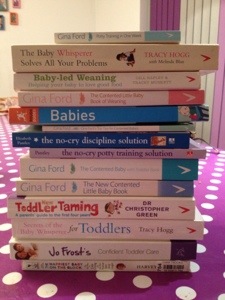
The debate concerned parenting books; the suggestion being that parenting books are responsible for stifling the natural instinct and intuition of parents. Callers of all ages made their points, with some arguing that allowing babies to “cry it out” is the only way to get a baby to sleep through the night. Others argued that Gina Ford’s ‘Contented Little Baby’ routine was both the work of the devil and equally the only possible option for raising a happy child. Several parents from older generations pointed out that none of these books and regimes were available “in their day” and their children turned out alright (even though, when pressed, at least one admitted that her children didn’t sleep through the night until the age of five).

Few topics polarise people as much as parenting. There are so many factors and variables along the rocky road that is parenthood and it’s such an important job. Nothing magnifies irrational thought as much as sleep deprivation and this is where parenting books come in. They can feel like a life-line when your instinct and intuition seem to be failing you.

The one thing all callers had in common was their passion. They all felt so strongly that they were right.

Had I been put on-air this morning, my point would have been this:
“Why does your way have to be the only way?”

Nobody on this particular radio show was able to appreciate that what works for them may not for someone else; all children are different and what works for your first child may not have the same effect on your subsequent offspring. Others may do things differently from you, and that’s fine. It doesn’t mean that they’re wrong or that you are, either.

The main topic of this phone-in was intuition, which I think is a really interesting point. The suggestion was that anyone following a routine from a parenting book was ignoring their own common-sense and instinct. The reason I felt compelled to join this debate was that this view is so incredibly black and white.

What if your intuition is telling you that you need help? Why ignore the wealth of information in books and online? What if you are seriously questioning whether you were over-looked on the day that maternal instinct and common sense were handed out? What’s so wrong with using a crutch?

20130430-220951.jpg

I admit that I’m somewhat of a parenting-book-junkie. Especially when Madam was born, in the early days and during the onset of what turned out to be severe post-natal depression, I was desperate for help. I bought book after book, determined to shoe-horn my little baby in to a routine that would get her through the night. Looking back, what I really needed was to feel in control. Anyone who’s ever had a newborn will know that control, hormones and little babies don’t usually go hand-in-hand.

The start of my darkest days coincided with trying to fit Madam in to Gina Ford’s routine. I just couldn’t seem to get her to “obey’ the timings that Ms. Ford insisted upon. I felt like an utter failure. Several of my peers had successfully implemented Gina, yet I simply couldn’t make her routine work. I think my baby was four weeks old. Had I been thinking rationally at the time, I’d have realised that either this routine wasn’t for us, or that we’d have to try later when the baby was a bit older. Perhaps I’d have taken some tips or ideas and found my own way. But I wasn’t thinking rationally. I was desperate. I bought several other books, determined to fit my tiny little baby in to some sort of schedule: to make me feel back in control of the situation and in hindsight, my life.

My fixation on routine was in all likelihood something for me to focus on. Of course I now realise that putting so much emphasis on getting little Madam in to a routine was causing me to miss out on so many joyful moments. I even felt resentful of her at times. Of course, much of this is closely tied in to PND. Also, thinking back, the control issue was also probably magnified by my inability to breastfeed her (more on this topic soon). I looked to parenting books to help me regain control as I felt completely unprepared for the spiral that my life had seemingly become.

With this in mind you’d think I’d be firmly in the anti-parenting book camp. But this is not the case. Not at all. My situation was extreme and I am in no way suggesting that any book was responsible for my depression. I did find a routine that worked for us (from Tracey Hogg’s ‘The Baby Whisperer Solves All Your Problems’), and Madam did sleep through the night from eight weeks. I say this not to brag, but to show that with perseverance I found something that worked. For me, the stress of implementing a routine was negated by the rewards. Getting the baby to sleep through the night as soon as she was ready helped me to feel more in control and made me more capable of seeking help for myself. I genuinely don’t believe that she’d have slept as early as she did without the routine.

I’m occasionally asked my views on Gina Ford and her routines. I would never dream of saying “Oh my God, Gina and I don’t get on at all, she nearly sent me insane. Steer well clear if you’d like to avoid taking up residence in a padded cell!”. I realise and accept that all children and all families are different. The reason there are so many books, ideas and baby products on the market is that there is something to suit everyone. I can only offer my own experiences and share what did and didn’t work for us. I try very hard to stick to point number five in my Mummy Kindness Manifesto:

I will only offer advice when it’s asked for. I will do so with love and without judgement.

When it comes to receiving parenting advice, experience has taught me to filter advice and to keep an open mind. It is perfectly acceptable to glean useful nuggets of information from an assortment of media and to disregard what doesn’t speak to or work for you.

There is no reason why reading parenting books should stifle our parental instincts or intuitions. If we have peace with and faith in our own choices as parents, there’s no reason why we should feel threatened by someone else’s different approach. I think this goes for all aspects of life, really, not only parenting. We all simply want to do our best for our families. Hopefully we can all continue to listen to our own instincts and at the same time respect and accept that others are doing the same, differently, and that’s fine too.